

Working in Switzerland, living in France: the frontalier guide 2026
You have three months to choose LAMal or CMU — and the choice is permanent. See both numbers side by side, free, before you commit.
Free tools · Free Net Frontalier app below · France ↔ Switzerland — more corridors coming
Cross-Border Pack — €29, in your browser
2027 édition — valid from today through 31/12/2027; no auto-renewal.
The €29 Cross-Border Pack runs on the web — personalised analysis + PDF, LAMal vs CMU report, CERFA choice form + canton sheet, CAF differential report, Geneva rectification dossier, 3-pillar retirement analysis, personalised frontalier guide, employer-co-signed presence attestation, art. 5a OIS leaver attestation — ready-to-send PDFs from your own situation.
Cross-border tools — €29Also in the Expat Starter bundle (Cross-Border + Patrimoine) — €39 on the pricing page
The cross-border toolkit on adminlanding.com
Every tool on this hub
7 free tools with no account, 5 more with an account, and the Cross-Border Pack: 2027 édition — valid from today through 31/12/2027; no auto-renewal.
LAMal vs CMU Comparison
Compare health insurance options side by side. Estimate monthly costs for both systems based on your household situation.
Try it freeTelework Day Counter
Project your telework days against both limits — the 40% tax threshold and the 49.9% social-security limit — and see your remaining margin.
Count your days freeDroit d'Option One-Stop
Your 3-month window computed to the day, the exact Swiss office for your canton, and what to do if the deadline has passed.
Check your window freeCMU Contribution Calculator
The 8% URSSAF formula on your own numbers: N-2 income, PASS abatement, the exact annual amount — free.
Calculate it freeNet Swiss Salary Calculator
Gross to net by border canton — AVS, LPP, accident insurance and tax at source, on your own figures.
Calculate it freeCAF Differential Calculator
Calculate your entitlement to French family allowances (allocations familiales) as a cross-border worker. Compares Swiss and French benefits — the PDF report is in the pack.
Calculate it freeQuasi-Resident Tax Analysis
Determine if you qualify for quasi-resident tax status in Geneva. Understand deductions and tax optimization opportunities — the rectification dossier is in the pack.
Check eligibility freeFree with an account
- Presence & telework calendar with your position against the 40 % and 49.9 % thresholds
- Droit d'option record (LAMal or CMU, with the date)
- Key-dates rail (option window, thresholds, year-end close, salary-data exchange) with e-mail reminders for the option window and the thresholds
- Retirement reference pages: AVS, LPP (2nd pillar), 3a (3rd pillar)
- Info hub: Permit G, taxation by canton, unemployment, social-security coordination, CHF/EUR
In the Cross-Border Pack — €29
Health-insurance choice
- Health-insurance choice form (CERFA 14445*03) with your canton office sheet
Reports as PDF
- Personalised cross-border analysis with its PDF report (health cover, taxes, allowances, retirement)
- LAMal vs CMU comparison report (PDF)
- Family-allowances differential report, 26 cantons (PDF)
- Geneva quasi-resident rectification dossier (DRIS/TOU, PDF)
- Personalised retirement analysis, 3 pillars (PDF)
- Personalised frontalier guide by canton and life stage (PDF)
Attestations
- Presence & telework attestation, co-signed by the employer (e-signature optional: 1 credit per signer, 2 signers, not included in the pack)
- Art. 5a OIS leaver attestation (employment ending in the year) — same optional e-signature
2027 édition — valid from today through 31/12/2027; no auto-renewal.
Get the Cross-Border Pack — €29What rules apply to a France-Switzerland cross-border worker in 2026?
Health Insurance: LAMal vs CMU
As a cross-border worker in Switzerland, you must choose between Swiss health insurance (LAMal — Loi fédérale sur l'assurance-maladie) and French health insurance (CMU/PUMa — Protection Universelle Maladie). You have 3 months from the start of your Swiss employment to exercise your right of option (droit d'option). This choice is generally irrevocable for the entire duration of your cross-border activity. LAMal typically has higher premiums but lower deductibles and broader Swiss coverage. CMU contributions are income-based (around 8% of fiscal reference income), which may be cheaper for lower incomes but more expensive for higher earners.
| Criterion | LAMal | CMU / PUMa |
|---|---|---|
| Country of coverage | Switzerland (Swiss insurer) | France (CPAM, French Sécurité sociale) |
| Premium basis | Flat per-person premium (varies by canton, age, deductible) | ≈ 8% of N-2 income above the allowance (25% of the income-year PASS) |
| Typical monthly cost (single adult, 2026) | ≈ CHF 521 (OFSP 2026 average, France-resident adult) | Income-dependent — €0 when N-2 income is at or below the allowance (€11,592 in 2026) |
| Care in France | Reimbursed via S1/E106 (or directly by insurer) | Reimbursed at French rates (Carte Vitale) |
| Care in Switzerland | Full Swiss coverage | Limited — emergencies only via EHIC |
| Best fit | Higher earners; care primarily in Switzerland | Lower earners; care primarily in France |
| Choice deadline | 3 months from start of Swiss employment | 3 months from start of Swiss employment |
To transmit the "choix du système d'assurance maladie" form, the CPAM de Haute-Savoie runs a dedicated online téléservice for frontaliers, frontaliers-suisses-cpam.fr — per the CPAM, the recommended way to send it: deposited in the dedicated space, it reaches the CPAM automatically in dematerialized form, with no paper copy needed (keep the originals in case of a control). Available 24/7.
Taxation: Where Do You Pay?
Your taxation depends on your canton of employment. Geneva applies tax at source (impôt à la source) in Switzerland — the tax is deducted directly from your salary. You may qualify for quasi-resident status if at least 90% of your worldwide income is earned in Geneva, allowing you to claim deductions similar to Swiss residents. For most other cantons (Vaud, Valais, Neuchâtel, Jura, Berne, Bâle-Ville, Bâle-Campagne, Soleure), the Franco-Swiss agreement of 11 April 1983 applies: you are taxed in France on your Swiss salary. In all cases, the Franco-Swiss double taxation convention of 9 September 1966 prevents double taxation.
Whichever canton applies, frontaliers resident in France file a French income-tax return — our French tax return guide covers the expat and cross-border cases step by step.
Telework: two distinct limits, not one rule
- Tax — 40%. Up to 40% of annual working time teleworked from France keeps the pay taxable in the employer state. In force 24/07/2025, applies from 01/01/2026. Temporary mission days (in France or third countries) count as telework within the 40% only up to a cumulative 10 days per year. Beyond 10 days only the EXCESS mission days become taxable in France; a mission day is a full day worked mostly abroad (ge.ch, 19/05/2026). Sources: SIF (admin.ch) — Entrée en vigueur de l'avenant FR-CH · ge.ch — Accords applicables au télétravail (personnes frontalières), maj 23/04/2026 · Décret n° 2025-838 du 21/08/2025 (Légifrance — texte de l’avenant) — verified 06/09/2026
- Social security — below 50% ("49.9%"). Below 50% of total working time teleworked from France can keep Swiss social-security affiliation (framework agreement, since 01/07/2023) — requires the employer-side A1 procedure; not automatic. Distinct from the 40% TAX threshold. Sources: CLEISS — Accord-cadre télétravail transfrontalier (07/2023) · OFAS/BSV (admin.ch) — Télétravail — verified 06/09/2026
Project your own year against both limits with the free telework day counter.
| Canton of employment | Where you pay income tax | Legal basis |
|---|---|---|
| Geneva (GE) | Switzerland — tax at source (impôt à la source) | Bilateral GE-FR agreement; quasi-resident option if ≥ 90% of income earned in GE |
| Vaud, Valais, Neuchâtel, Jura, Berne, Bâle-Ville, Bâle-Campagne, Soleure | France — declare Swiss salary on French return | Franco-Swiss agreement of 11 April 1983 |
| All other cantons (default) | Switzerland — tax at source | 1966 Franco-Swiss double-taxation convention (avoids double tax in France) |
Social Security & Family Allowances
Social security coordination between France and Switzerland follows EU Regulation 883/2004 (applicable to Switzerland via bilateral agreements). As a frontalier, you are generally covered by Swiss social security for work-related benefits. For family allowances, priority depends on who works where (art. 68 of Regulation 883/2004): in a mixed household where the other parent works in France, France pays first through the CAF and Switzerland pays a differential supplement; when both parents work only in Switzerland, Switzerland pays in full and a French top-up exists only where French rates are higher. The FAQ below and the family-allowances calculator apply that rule to your household.
Retirement: The Three Pillars
- 1st pillar (AVS/AHV): Swiss state pension. Contributions are mandatory (split between employer and employee). The reference age is 65 for men; under the AVS 21 reform, women's reference age is rising from 64 to 65 in three-month steps from 2025, reaching 65 for those born in 1964 or later. Periods worked count toward your pension from both countries.
- 2nd pillar (LPP/BVG): Occupational pension. Mandatory for employees earning above CHF 22,680/year (2026). When you permanently leave Switzerland, you may be able to withdraw your vested benefits or transfer them to a vested benefits institution (freizügigkeitskonto).
- 3rd pillar (3a): Private retirement savings with tax advantages. Deductible from Swiss taxable income (max CHF 7,258/year for employees with 2nd pillar, 2026). Available to all Swiss taxpayers including frontaliers taxed at source in Geneva.
CMU for frontaliers: how the contribution works
Frontaliers who choose the French system (CMU/PUMa) pay an income-based contribution, not a flat premium. The rate is 8% of your N-2 income (the year before last) after a fixed abatement of 25% of the PASS (the French social-security ceiling), prorated by days worked over 365. It is computed and collected by the STFS (ex-CNTFS) through URSSAF. Calculate your own contribution — free.
Sources: Préfecture de la Haute-Savoie — Montant de votre cotisation (maj 20/08/2025) — verified 04/08/2026
The PASS is revalued every January, so the euro amount changes each year even at constant income. For your exact figure, use the official simulators and pages: URSSAF simulator · ameli.fr — frontalier suisse.
The CMU route only exists if you exercise the droit d'option in time. 3 months from starting Swiss employment (or taking French residence / first Swiss pension payment). Silence ⇒ automatic LAMal affiliation. One-time, irrevocable except on enumerated status changes.
Sources: ameli.fr — Travailleur frontalier suisse (maj 30/04/2026) · CLEISS — FAQ droit d'option des frontaliers France-Suisse — verified 04/08/2026
To see whether CMU or LAMal costs you less on your own numbers before the window closes, run the free LAMal vs CMU calculator.
Two more free frontalier calculators: your net Swiss salary and your cross-border family allowances.
Built for documents that matter
Leases, tax forms and identity documents deserve more than a template site.
eIDAS e-signature
EU Regulation 910/2014 — sign leases remotely, legally.
Encrypted on your device
Vault documents are encrypted before upload — we can't read them.
Hosted in the EU
Frankfurt, europe-west3 — GDPR by architecture, not by promise.
Every article cited
Templates reference their legal basis — ALUR, ELAN, Code civil.
“As an expat renting out my apartment in France, I had no idea where to start. […] The biggest thing for me is that it explains everything clearly.”
Daniel, 5/5 — July 2026
Read all 2 reviews on TrustpilotBuilt in Annecy by Julien Maurice — AdminLanding SASU, SIREN 101 595 734 (RCS Annecy)
Quick answer
A France-Switzerland cross-border worker has 3 months from their first day in Switzerland to choose health cover: LAMal (Swiss premiums) or the French CMU/PUMa (around 8% of fiscal reference income). The choice is irrevocable and the default is LAMal. Taxation depends on the canton: Geneva taxes at source in Switzerland — with quasi-resident status if at least 90% of your income is earned there — while Vaud, Valais, Neuchâtel, Jura, Berne, Bâle and Soleure tax you in France under the 1983 accord. Telework has two distinct limits: up to 40% of annual working time keeps the pay taxable in the employer state (avenant to the 1966 FR-CH tax convention, in force 24/07/2025, applicable from 01/01/2026, mission days counted only up to 10 per year), while strictly below 50% — displayed as 49.9% — can keep Swiss social security via an employer-side A1 request (EU/EFTA framework agreement, since 01/07/2023). The free telework counter, the LAMal/CMU calculator, the free Net Frontalier app and the €29 Cross-Border Pack give you the numbers, the documents and the day count. AdminLanding runs the LAMal/CMU comparison and the telework count on your own numbers, free.
Frequently Asked Questions
Cross-border work, health insurance, telework limits, taxation, and retirement.
What is the LAMal/CMU right of option (droit d'option)?
How are cross-border workers taxed in Switzerland?
How many days can a frontalier telework from France?
What is the Permit G?
Can I claim French family allowances (CAF) as a frontalier?
How does retirement work for cross-border workers?
What happens if I lose my job in Switzerland?
Take it with you — Net Frontalier, the free app
Free app to estimate your France-Switzerland net take-home pay, compare LAMal vs CMU health insurance, and check your tax situation — in seconds, in your pocket.
Get Net Frontalier on Google Play Download on the App Store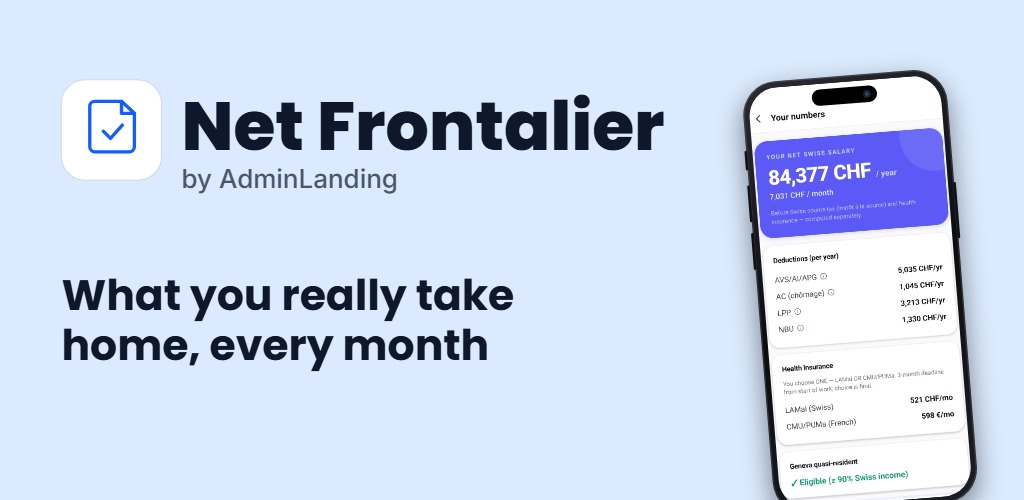

Net take-home & full breakdown

Your situation, a few taps

Share your result
Important: AdminLanding is a technology platform, not a financial advisor, tax consultant, or insurance broker. The information provided is for general guidance only and does not constitute professional advice. Cross-border taxation and social security rules are complex and change frequently. Always consult a qualified professional (fiduciaire, tax advisor, or insurance broker) for your specific situation. Key references: CLEISS (cleiss.fr), OFSP (bag.admin.ch), impots.gouv.fr, AFC (estv.admin.ch).
Secure Vault — included with every pack
Store your generated documents in an encrypted vault. Administrative Intelligence reports, fiscal analyses, CERFA forms, rent receipts, letters — all your generated documents in one secure place, encrypted on your device before upload.
Simplify Your Cross-Border Life
2027 édition — valid from today through 31/12/2027; no auto-renewal. The LAMal/CMU report, the CAF and Geneva dossiers, the 3-pillar retirement analysis — all in one place.
Get the Cross-Border Pack — €29EU-hosted • Bilingual FR/EN • Encrypted vault included
Editorial deep-dives
Want the longer version of this story?
AdminLanding ships the operational tools. The editorial sites — ExpatAdminHub for expat / cross-border life and GreenDailyFix for renovation aid — go deeper on the why and the how.
Permit G Switzerland — full cross-border worker guide
Eligibility, application, the 49.9% telework rule, what changes with cantonal residence, and the renewal pitfalls frontaliers fix too late.
LAMal vs CMU — health insurance for cross-border workers
The droit d'option deadlines, what gets covered on each side, dependent rules, and the calculation that decides which is cheaper for your household.
Swiss 2nd Pillar (LPP) — frontalier retirement guide
What you can withdraw on departure, what stays locked until retirement age, and the tax implications on the French side that catch frontaliers off guard.
Free tools on AdminLanding
Your data is handled with strict protection and EU hosting practices.